

NOTE: The developer has been issuing patches since launch that could have addressed issued mentioned in this review at time of publishing.
In the world of games that make you squint, turn your head to the side and ask “wait is this Resident Evil?”, Vultures – Scavengers of Death is the most curious one to come around it awhile. Trading third-person (and I guess now first person) action for turn-based tactics. After playing through most of the campaign, I’m convinced this genre facelift isn’t just a gimmick. There’s something about the tension of strategy games that melds pretty well with survival horror sensibilities. That said, I don’t think Vultures is the best product of this fusion. As many times as I was charmed by its cleverness, I was also frustrated by its obtuse AI and frustrating bugs.
I enjoyed how tiptoeing around maps would snap seamlessly into combat should mutants catch wind of, or straight up ambush, you. It can’t recreate the trepidation that slow walking through a dark hospital with gurneys full of zombies produces, but it does tickle a pragmatic and technical set of gears in the brain. When the COMBAT STARTED dialog fills the screen, I’m instantly thinking about spacing, action and movement point efficiency, and gear options. Can I successfully launch a good offense and have enough movement to avoid counter attacks this turn? How many turns until I run out of floor and box myself into a corner? It’s these moments that I am most like the me that is pushing through dark halls as Leon Kennedy. I’m not afraid of the boogeyman around the corner, I’m afraid I might now have enough bullets for him.
Hypothetically anyway. In practice, I spent most of Vulture’s 10 hour campaign pretty well-stocked. I wasn’t overwhelmed with ammo and gear drops so much as I didn’t have to spend these resources most of the time, because combat with general enemies was a puzzle that was easy to solve early on. Your characters, the gruff and tough Leopaldo and sleek and sexy Amber, have various actions they can spend a limited pool of action points on like shooting a gun, using a healing item, or crucially, pushing enemies around.
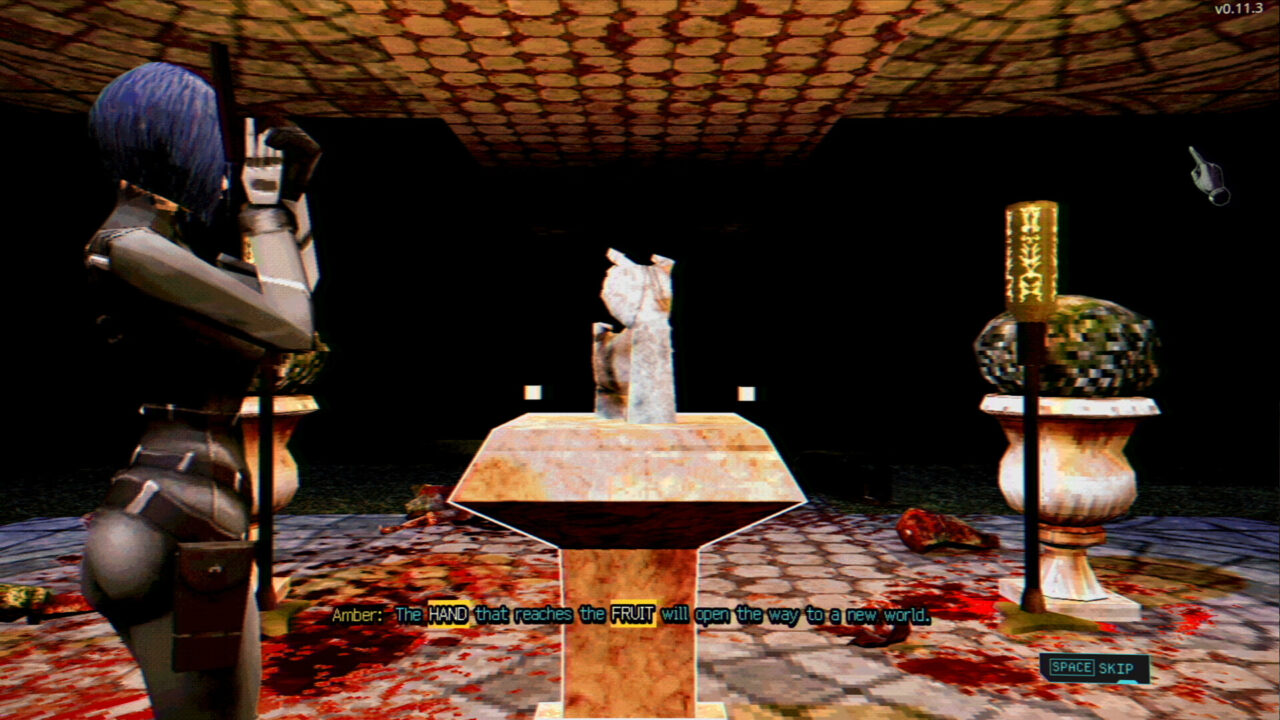 Both characters are almost identical as far as actions they can take in and out of combat, with the exception of Amber’s grappling hook, which can pull enemies towards her (or yank shields out of their hands), pull her across gaps and over hazards. Combat in Amber’s levels have an added depth because of this tool and the level is designed to give you plenty of opportunities to use it, and generally makes playing as Leopoldo feel bad in comparison, who may have some sort of unique function about him but I never really noticed it.
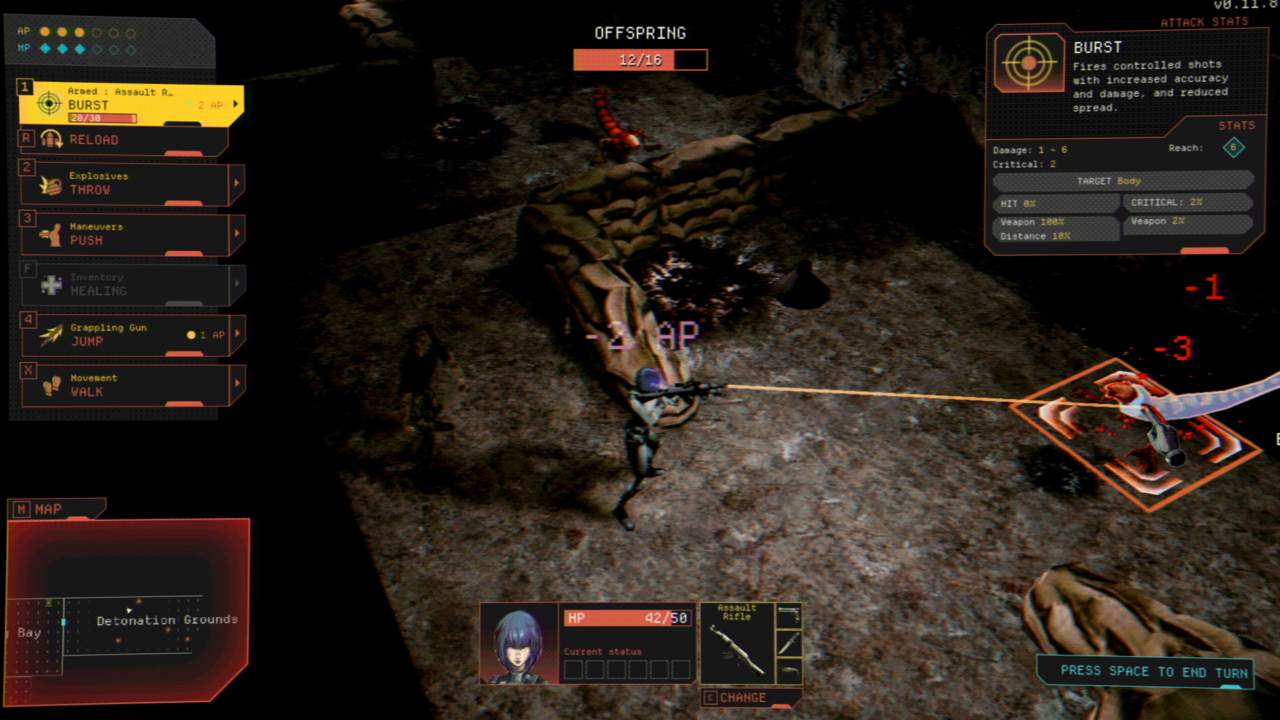
Melee and ranged attacks can be directed towards specific parts of enemy bodies, with each area providing some benefit over others. Torsos are the easiest to hit, attacking the head does more damage but costs more AP, etc. Shooting and stabbing legs can immobilize enemies, which when done right before pushing and enemy away from you to avoid attacks, becomes a bread and butter combo for keeping yourself safe on the cheap. If you can do it with a knife, which has a good chance of causing enemies to bleed every turn, and you have a great recipe for neutering most fights. This has the add-on effect of boss fights going out in a whimper rather than a bang, as I often had a stock pile of grenades and bombs and the like ready to dump on them on site.
The difficulty curve does eventually start to catch up to this dynamic, introducing stage hazards around mid game and stepping up the amount and complexity of the enemies towards the end. That said, I felt like I was coasting through most of this game. Even on the occasions that I did die, it often introduced a factor I realized too late and, once implemented, trivialized the next try at it.
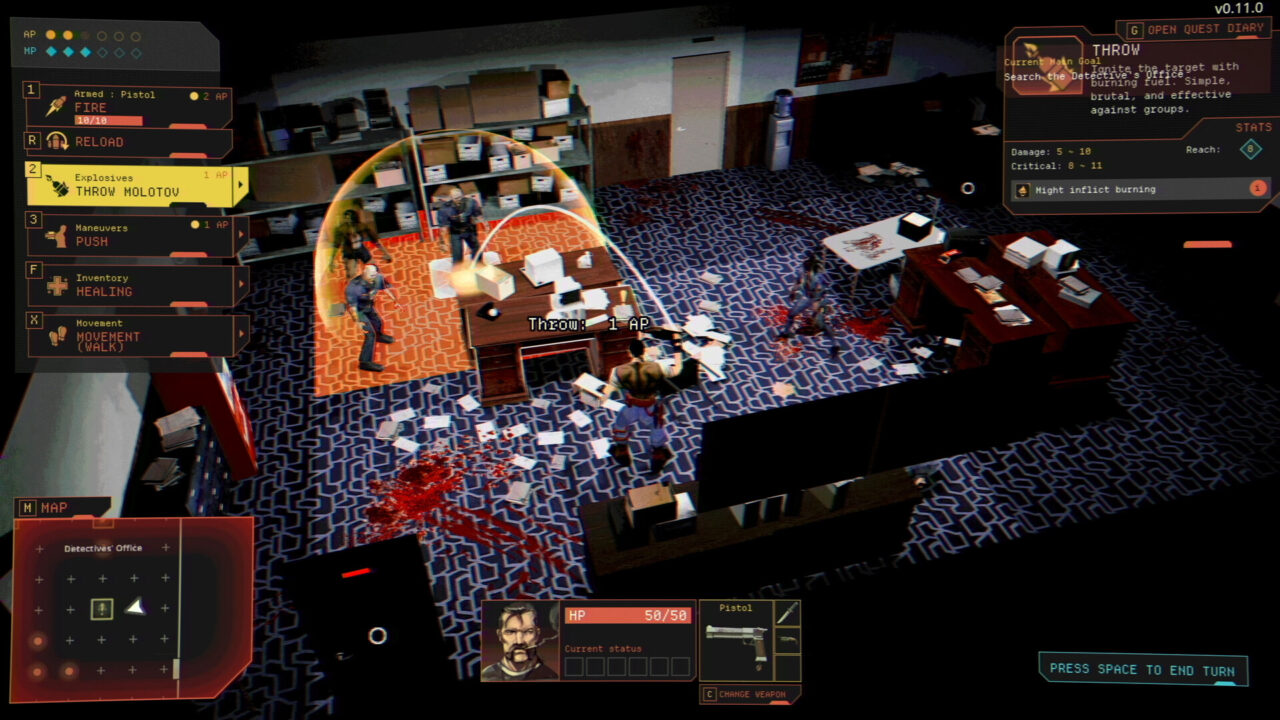 When I had to resort to weapons that weren’t the default pistol and knife, I was happy to find that almost all of them perform completely differently and have very unique strengths and weaknesses. If I needed something with more umph, the shotgun fired in a shallow cone that could also push enemies around on impact. If the numbers game was getting the best of me, spray from the assault rifles wide range could pepper many enemies multiple times, but relatively randomly. Even in melee, trading the keen edge of the knife for the stun club gave me some ability to stun enemies, and even paralyze them with electricity should I have the battery power to. Stopping zombies from moving or acting is the most powerful thing you can do in Vultures and you have an abundance of ways to do it from the jump.
No tools were strong enough to protect me from the myriad bugs I encountered in combat scenarios though, some of them occasionally forcing me to restart a mission from my last save altogether, like a moment of brilliance I had luring a blade-handed hunter mutant into dashing itself into a trap door sending it careening into the darkness below and never making it to me, only to realize that the joke was on me because the game never progressed past the state of it falling and me moving on to capitalize on my prowess. One mission in a mansion courtyard had an encounter I had to restart three separate times because burrowing enemies kept trying to unearth themselves from immovable objects, and I couldn’t move on from the room without dealing with them first. When people think of indie developers, they think of low resolutions and small scopes but sometimes forget that indie also sometimes means not enough resources for QA.
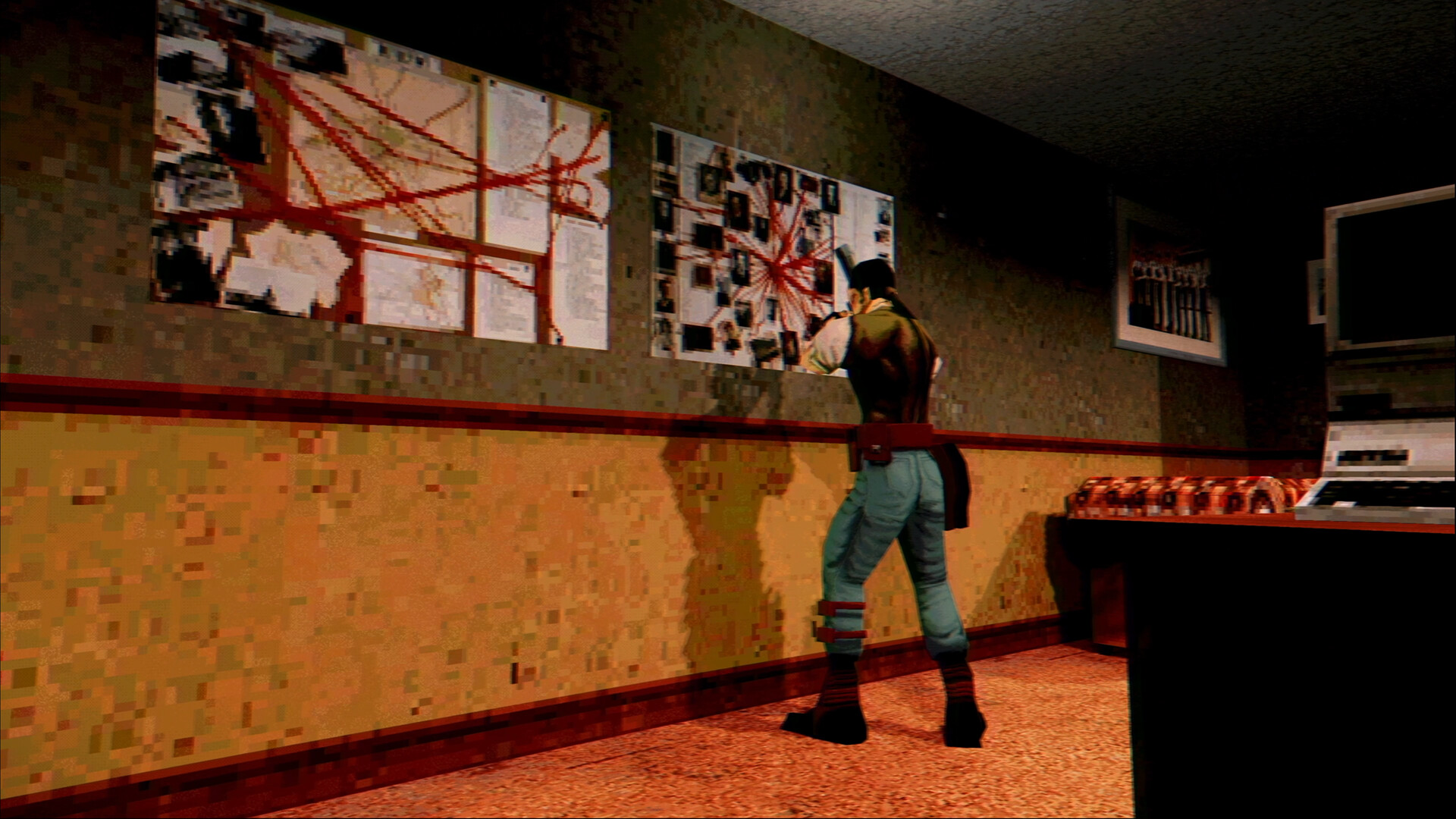
The “tiptoeing around maps” part that comes between the combat walks the line between semi-compelling environmental mystery and obsessive item hunt well enough. The PSX-through-a-CRT art style helps set the expectation that every underground cave, sinister science lab, or dilapidated urban center is definitely inspired by the games you think they are. Environments are muddy and dark, but evocative and sometimes even didactic. But most of the time, each level is just a new look wrapped around similar sorts of exploration dynamics.
 Speaking to the item hunt of it all, managing inventory was often my constant point of tension, as I kept hoovering everything I came across into my limited pockets, having to make frequent runs back to storage crates to unload. I liked this approach to scarcity. On the off chance a combat scenario was giving me issues, they stemmed less from that I didn’t have the resources and more that I didn’t bring the right ones with me. The necessity for proper preparation was where Vultures nailed survival horror the most consistently.
Hypothetically, combat shouldn’t have to be the only option. Stealth is a factor here, as throttling your walk speed to basically a crawl and avoiding enemies vision ranges means you can maybe pass through rooms completely unnoticed. While in combat, you can spend an action point to open a door and leave a room and end the battle prematurely, but this isn’t a great option if you ever want to return to that room again, as the monsters in it will have, without fail, crowded the entrance and will get free shots on you when you return. This sort of meant that whenever you started combat, you have to be certain your prepared to kill everything involved. Not very survival horror, in contrast.
But as an answer to a question no one was really asking, Vultures – Scavengers of Death really does present the first solid argument for moving the classic horror subgenre into new forms and functions. Especially in the same year as Capcom drops one of its more remarkable entries in its flagship mother series, Resident Evil, Vultures is like a great “if you liked that, try this” entry despite its imperfections. It did feel like a pretty solved equation early on though, with the “correct” dominant strategy being completely antithetical to exploring the really fun and diverse weapon options most of the time. It’s very buggy, and lacks too many real eye opening moments or surprises as you progress through it, but I think it succeeds in being a worthwhile curiosity to fans of either strategy games or horror in general, and has some potential to be even better if post launch support can rescue it from itself.
Code was provided for review.


